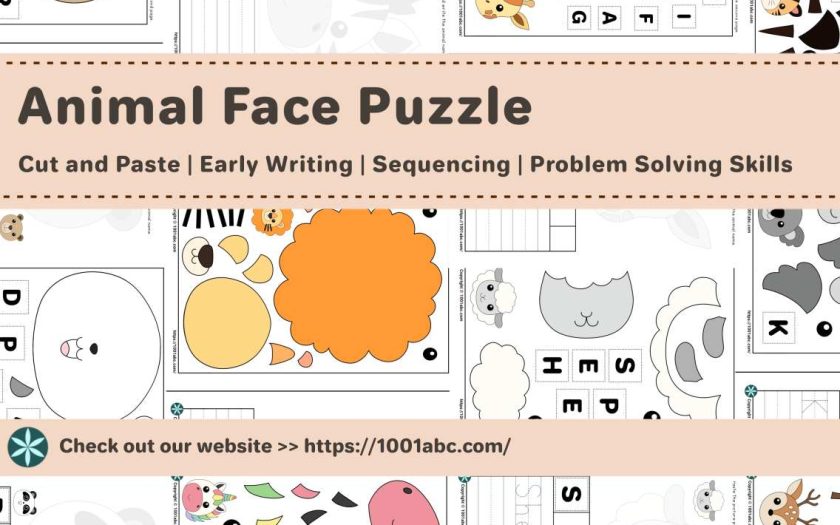
These printable cut-and-glue animal worksheets are designed for preschool and kindergarten children who are starting to explore letters, shapes, and simple problem-solving. Each worksheet includes two pages:
- Page 1: Children cut out picture parts and letter pieces.
- Page 2: Children arrange, paste, and then trace and write the animal’s name.
These activities combine hands-on crafting with early literacy development, turning simple tasks into meaningful learning experiences at home or in the classroom. They support key areas of early childhood development, including fine motor skills, hand-eye coordination, early cognitive development, and visual-spatial awareness.
Task Overview
In these worksheets, children are invited to work through a simple, hands-on sequence:
- Cut out animal face pieces and letter tiles
- Explore and arrange the parts to form a complete image
- Paste the pieces onto a base page to build the animal face
- Trace and write the animal’s name
The activity brings together art, early literacy, and logical thinking. Children are encouraged to work at their own pace, make small decisions, and refine their movements through repetition. As they work, they begin to connect what they see with what they read and write.
Marterials Needed
- Child-safe scissors
- Glue (stick or liquid)
- Pencil, crayon, colored pencils, or markers
Learning Objective
Through this activity, children are given opportunities to:
- Refine fine motor control: cutting, placing, and pasting small pieces.
- Develop hand-eye coordination: aligning visual input with purposeful movement.
- Strengthen visual discrimination: identifying and matching shapes, parts, and letters.
- Build early language awareness: recognizing and forming simple animal names.
- Prepare for writing: tracing and controlled hand movements.
- Connect symbols with meaning: linking animal images to written words.
- Practice sequencing: completing the activity step by step.
- Sustain attention and build concentration, while working with increasing independence.
Instruction
- Set up a clean, calm workspace with all materials within the child’s reach.
- Present the worksheet and demonstrate the basic steps once, slowly and with minimal explanation.
- The child cuts out the picture parts and letter tiles from the first page at their own pace.
- The child places the picture parts on the second page, then arranges the letters to form the animal’s name. Allow time to adjust and self-correct.
- Once satisfied with the arrangement, the child pastes the pieces in place using glue.
- The child traces the animal name, then attempts to write it independently.
- The teacher, parent, or educator stays nearby and observes, offering guidance only when needed. Simple prompts may be used instead of direct correction (e.g., “What letter comes first?” or “Does this look right?”).
Skills Practiced
- Cutting along straight and curved lines
- Holding and controlling scissors safely
- Applying glue to small paper pieces
- Placing and aligning pieces on a page
- Recognizing and matching letters
- Arranging letters to form simple words
- Following a sequence of steps in order
- Tracing letters and simple words
- Copying letters to write independently
- Paying attention to details when positioning parts
Variations and Extentions
- Sorting activity: Mix pieces from different animals. The child sorts before beginning the task.
- Rebuild task: Disassemble and ask students to rebuild THE animal face on the tabfrom memory.
- Decorate the worksheet: encourage children to personalize their work by adding simple decorations such as sun, clouds, stars, or patterns around the animal.
- Animal sounds: imitate each animal together.
- Storytelling: use the animal face to create a simple story.
- Conversation: ask open-ended questions to encourage conversation and critical thinking.
Age Adaptation
- Younger children (3–4 years): provide pre-cut pieces and focus on matching and pasting.
- Older children (5–6 years): encourage independent cutting and writing without tracing.
Cut and Paste – Tracing – Writing – Animal Worksheets
Download our animal-themed cut-and-paste, tracing, and writing worksheets designed for preschool, kindergarten, and ESL learners. Click the link below the image to access the high-quality PDF for printing.
Panda
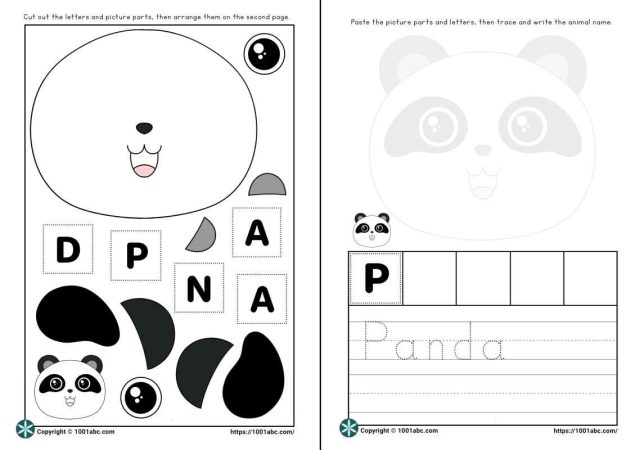
- Activity: Build the panda’s face, arrange the letters, then trace and write “Panda”.
- Observe: Black eye patches may help pandas recognize each other, reduce glare, and improve vision in bright light.
- Conversation: “Why do you think pandas mostly eat bamboo instead of other plants or meat?”
Koala
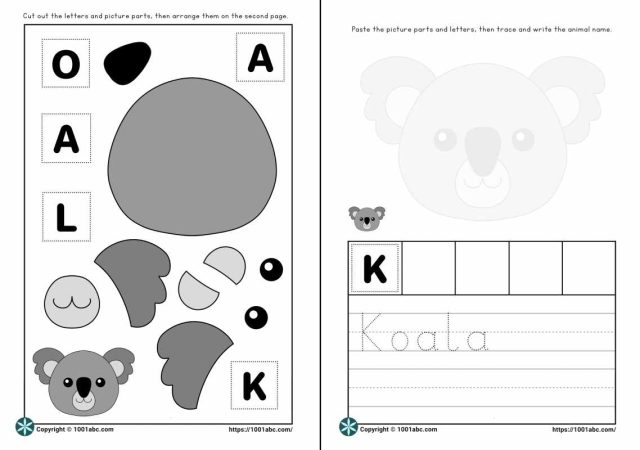
- Activity: Build the koala’s face, arrange the letters, then trace and write “Koala”.
- Observe: Big furry ears that help it stay warm and hear better.
- Conversation: “How might living in eucalyptus trees affect the way koalas sleep and move?”
Giraffe
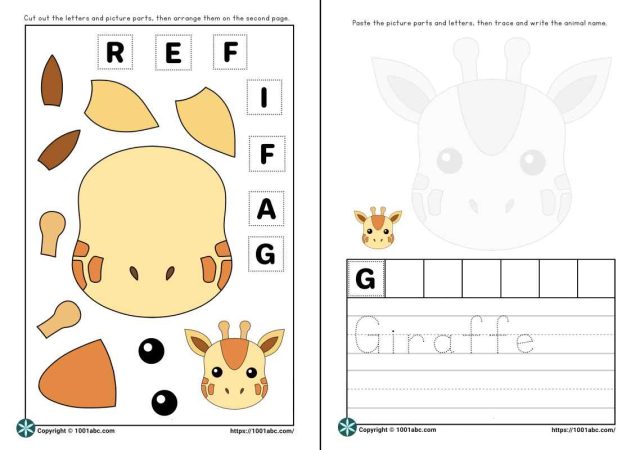
- Activity: Build the giraffe’s face, arrange the letters, then trace and write “Giraffe”.
- Observe: Long face with strong lips for reaching and eating leaves from tall trees.
- Conversation: “How do you think a giraffe’s long neck helps it survive in its environment?”
Bear
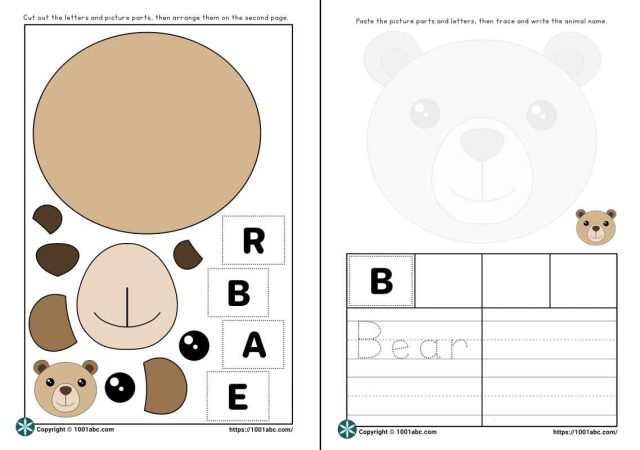
- Activity: Build the bear’s face, arrange the letters, then trace and write “bEA”.
- Observe: Strong snout with an excellent sense of smell for finding food.
- Conversation: “How might a bear’s ability to eat many types of food help it survive in different seasons?”
Zebra
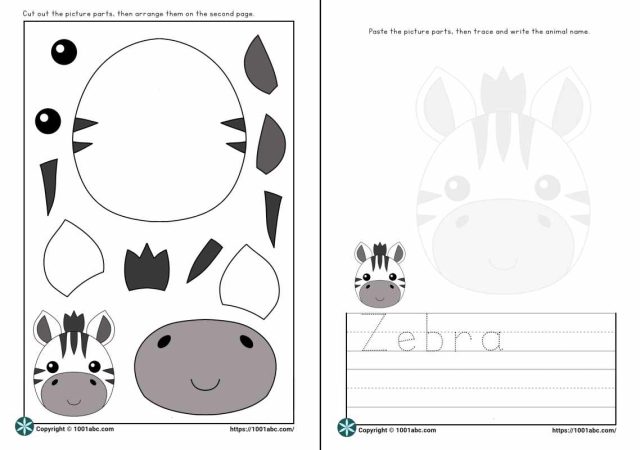
- Activity: Build the zebra’s face, then trace and write “Zebra”.
- Observe: Striped face pattern that helps with group recognition and confuses predators in herds.
- Conversation: “How might living in a herd help zebras avoid predators?”
Deer
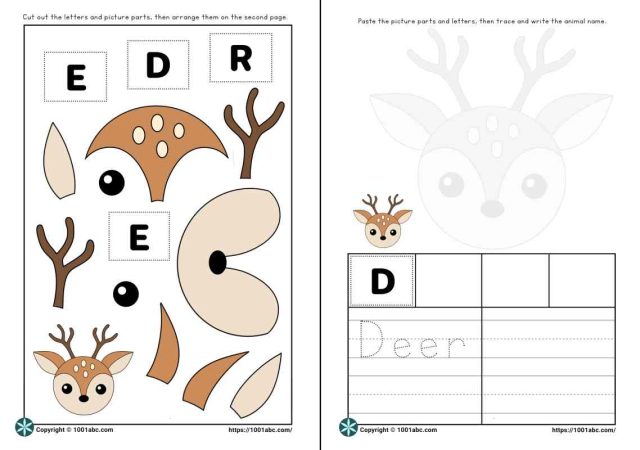
- Activity: Build the deer’s face, arrange the letters, then trace and write “Deer”.
- Observe: Large ears that can rotate to detect sounds from predators.
- Conversation: “How do a deer’s senses help it stay safe from predators?”
Lion
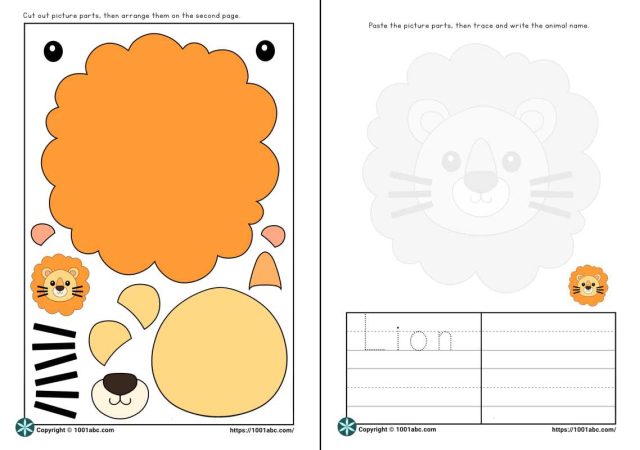
- Activity: Build the lion’s face, then trace and write “Lion”.
- Observe: whiskers help sense surroundings, and a mane in males helps with protection and display.
- Conversation: “How does hunting in a group help lions catch their food?”
Tiger
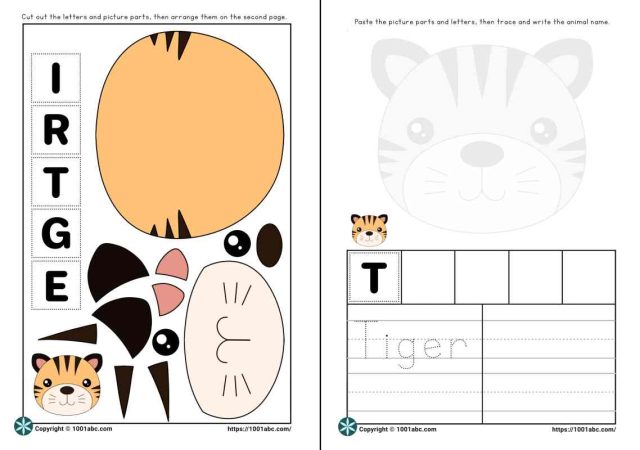
- Activity: Build the tiger’s face, arrange the letters, then trace and write “Tiger”.
- Observe: Facial whiskers that help detect nearby objects and movement.
- Conversation: “Why do you think tigers prefer living alone rather than in groups?”
Sheep

- Activity: Build the sheep’s face, arrange the letters, then trace and write “Sheep”.
- Observe: Side-facing eyes that give a wide field of view to spot danger, and woolly fur around the face that helps keep it warm.
- Conversation: “Why might sheep prefer to live in groups instead of alone?”
Unicorn
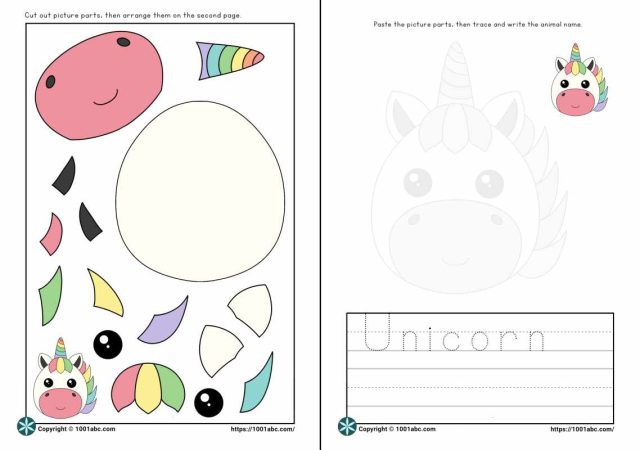
- Activity: Build the unicorn’s face, then trace and write “Unicorn”.
- Observe: A horn that represents a magical feature in stories about a mythical animal.
- Conversation: “If unicorns were real, what kind of environment do you think they would need to live in and why?”
***
Enjoy every moment of learning and growth with the children!