Description
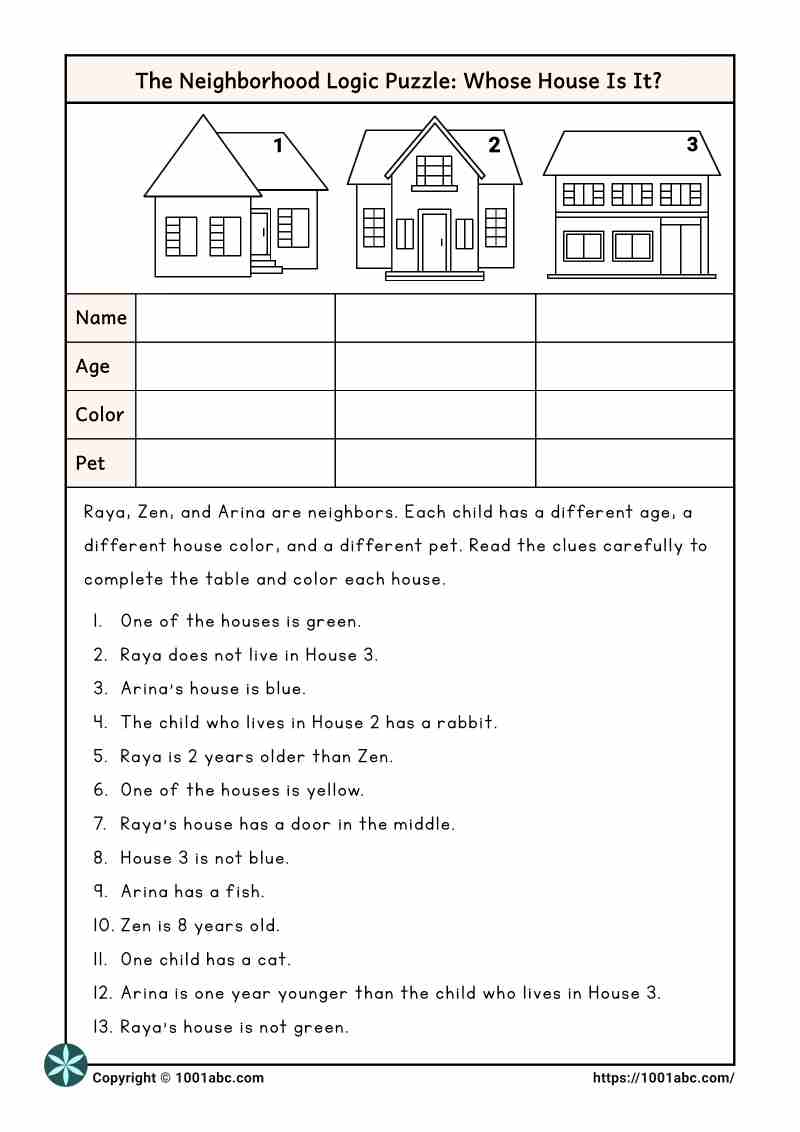
This worksheet combines reading comprehension with logical reasoning through a neighborhood-themed puzzle. Children read a series of clues about three neighbors (Raya, Zen, and Arina ) and use the information to determine each child’s house, age, house color, and pet. As they solve the puzzle, they record their findings in a table before coloring each house according to the completed solution.
Learning Concept
Logic puzzle activities encourage children to read with a purpose. Each clue provides one piece of information, and many clues must be combined with others to reach a solution. Through the puzzle, children organize information, eliminate impossible options, and draw logical conclusions based on the available evidence.
The activity also demonstrates that reading is a tool for solving problems rather than simply finding answers to isolated questions. Children practice gathering evidence from text, keeping track of information, and revisiting earlier clues as new details emerge. The logic table serves as a visual organizer that supports systematic thinking while reducing unnecessary memory demands, allowing children to focus on reasoning.
By combining literacy, logical thinking, and a hands-on coloring task, this worksheet is designed to strengthen language comprehension and higher-order thinking skills in a meaningful way.
Learning Focus
- Reading comprehension: extracting and interpreting information from multiple clues.
- Logical and deductive reasoning: connecting clues, making inferences, and eliminating impossible answers.
- Information organization: recording evidence systematically in a logic table.
- Sequential reasoning: solving the puzzle one clue at a time while building on previous discoveries.
- Working memory: holding relevant information while processing new clues.
- Attention to detail: identifying small but meaningful differences between clues.
- Executive function: planning, monitoring, and revising decisions during problem solving.
- English vocabulary: related to houses, colors, pets, ages, and comparative language such as older and younger.
- Visual representation: translating the completed solution into colored house illustrations.
Prerequisite Skills
Before using this worksheet, children should be able to:
- Read simple English sentences independently.
- Understand basic vocabulary related to houses, colors, numbers, and common pets.
- Understand comparative words such as older and younger.
- Follow multiple clues to solve a problem step by step.
- Record information in a table and use it to make logical conclusions.
Instruction
- Read each clue carefully.
- Use the clues to complete the table with the correct house number, age, house color, and pet for each child.
- Cross-check each new clue with the information you have already recorded before filling in another answer.
- When the table is complete, color each house with its correct color.
- Review your completed puzzle to make sure every clue matches your final answer.
Worksheet Download
Download: Logic puzzle – neighborhood (PDF)
Find similar worksheets: Educational Worksheets.
***
Related posts:
Explore:
***
Please visit Free Printable, to get more coloring pages and worksheets for kids.