Introduction
Number sense 1–10 includes understanding numbers from 1 to 10 as quantities and recognizing that the same quantity can be represented in different ways. Children develop this understanding as they connect number words and numerals with quantities they can see, count, and compare.
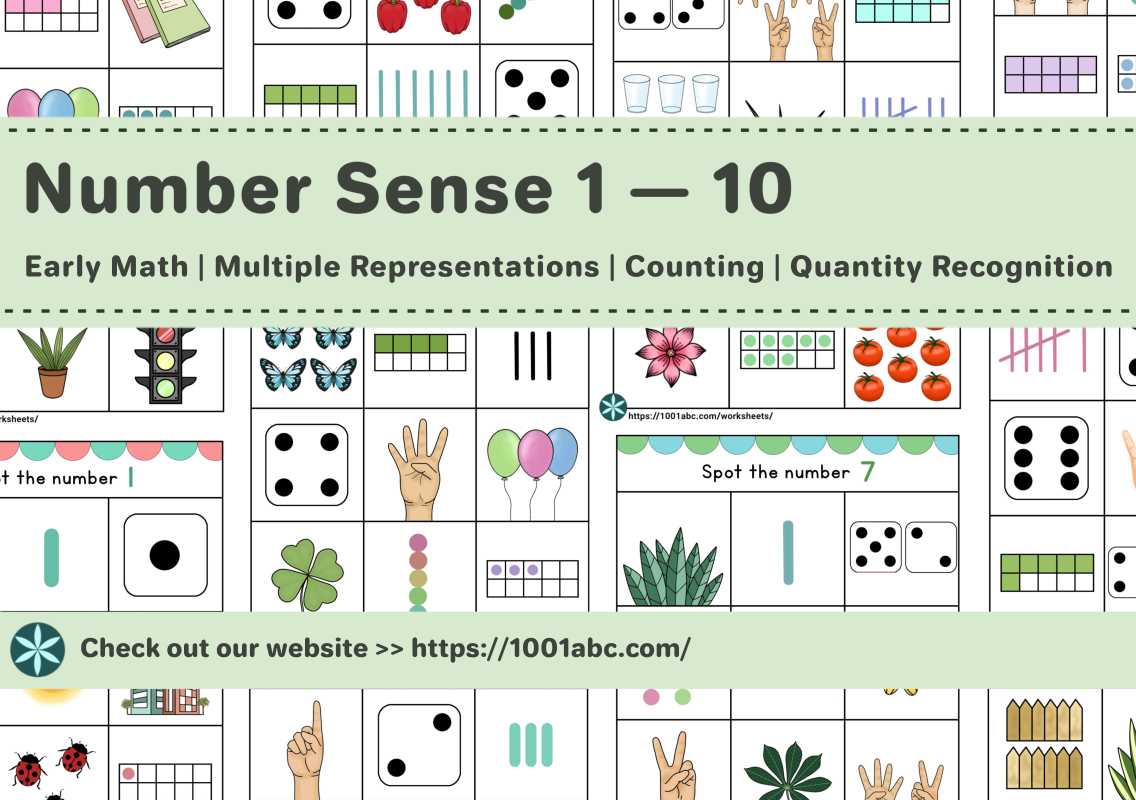
These number sense worksheets provide practice with numbers 1–10 through multiple visual representations. The quantities may be shown using objects, fingers, dots, ten-frames, dice patterns, or other visual forms.
Children look at the target number and spot the boxes that represent the same quantity. The activity requires them to compare different visual representations and connect each representation with its corresponding number.
Task Overview
Each worksheet focuses on one target number from 1 to 10 and contains 12 boxes with different quantities.
For example, on the “Spot the number 4” worksheet, some boxes may show four objects, four fingers, four dots in a ten-frame, or another representation of four. Other boxes show different quantities.
Children look across the boxes and find all the representations that match the target number. They can circle or mark the matching boxes. For younger children, they can point to the boxes and say the number instead.
The basic task remains the same throughout the collection. The target number changes from 1 to 10, while the quantity may appear in different visual forms.
Learning Objectives
Through these activities, children are given opportunities to:
- connecting numbers with their corresponding quantities;
- recognizing the same quantity in different visual forms;
- identifying a target quantity among other quantities;
- counting objects or visual elements when needed;
- comparing quantities with a given number.
Learning Focus
- Number–quantity correspondence: Connects a target number with visual representations of the corresponding quantity.
- Quantity recognition: Identifies groups of objects, dots, or other visual elements that contain a specified number.
- Multiple representations: Recognizes that the same quantity can be shown using different visual forms.
- Visual discrimination: Distinguishes representations of the target quantity from other quantities presented on the page.
- Counting: Counts objects or other visual elements when determining the quantity represented.
- One-to-one correspondence: Matches each counted item with one counting word when determining a quantity.
- Visual comparison: Compares different quantities to determine which ones correspond to the target number.
Learning Level & Adaptation
The worksheets are suitable for children who are beginning to work with numbers and quantities from 1 to 10. They can be used in preschool and kindergarten settings, depending on the child’s existing number knowledge.
Children should generally be able to:
- recognize or name some numbers from 1 to 10;
- count small groups of objects;
- use one-to-one correspondence when counting;
- compare a counted quantity with a target number.
The task can be adapted by:
- starting with smaller numbers;
- allowing children to count each group;
- using counters or other concrete objects alongside the worksheet;
- reducing the number of choices when necessary;
- asking children to point to the answers instead of marking them.
Children who are ready for more challenge can be asked to explain how different representations show the same quantity or create another representation of the target number.
Progress through the worksheets is best determined by the child’s prerequisite skills rather than age or grade alone.
Guidance
- Introduce the activity with concrete objects such as counters, blocks, or small toys.
- Explain that the same number can be shown in different ways.
- Encourage children to count when they are unsure about a quantity.
- Ask children to explain how they know that a box represents the target number.
- Let children recognize familiar patterns, such as fingers or dice patterns, without counting when they can identify the quantity directly.
- Remind children that different arrangements can represent the same quantity.
- Work through the numbers at the child’s pace rather than requiring all 10 worksheets to be completed at once.
Download: Numbers Sense 1-10 Worksheets
Our number sense worksheets contain 10 pages covering numbers 1–10. Click the download page link below each worksheet to access the individual article and printable PDF.
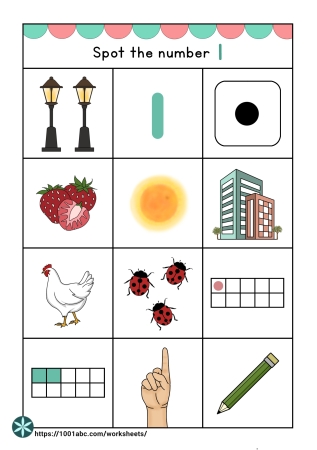
Spot the Number 1
Download page: Number sense 1
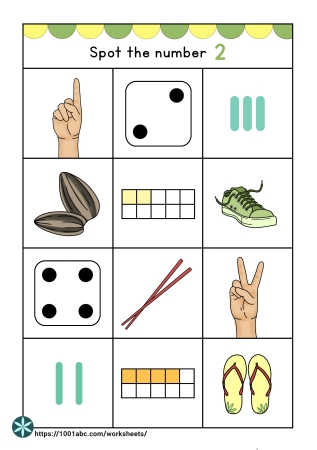
Spot the Number 2
Download page: Number sense 2
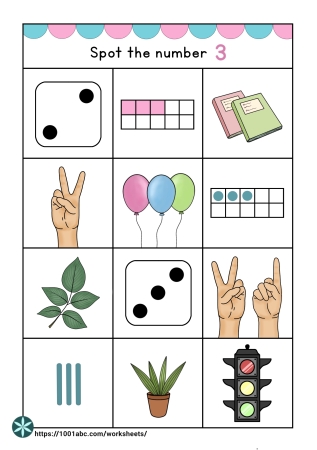
Spot the Number 3
Download page: Number sense 3
Spot the Number 4
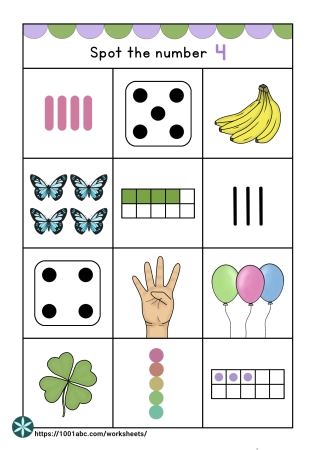
Download page: Number sense 4
Spot the Number 5
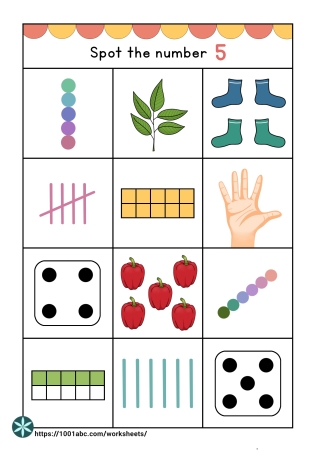
Download page: Number sense 5
Spot the Number 6
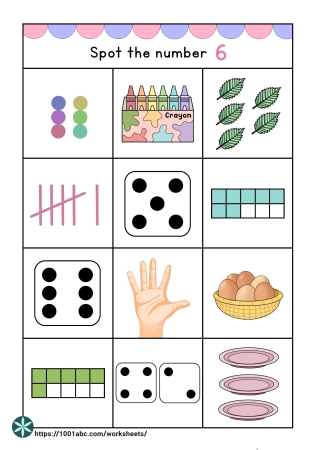
Download page: Number sense 6
Spot the Number 7
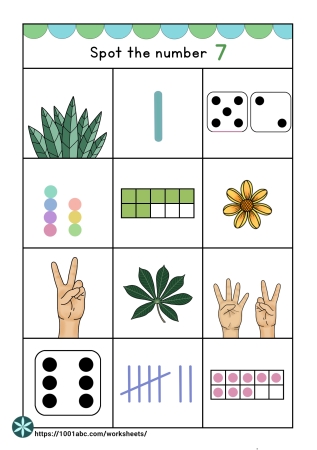
Download page: Number sense 7
Spot the Number 8
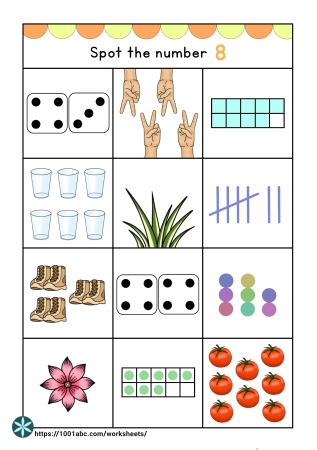
Download page: Number sense 8
Spot the Number 9
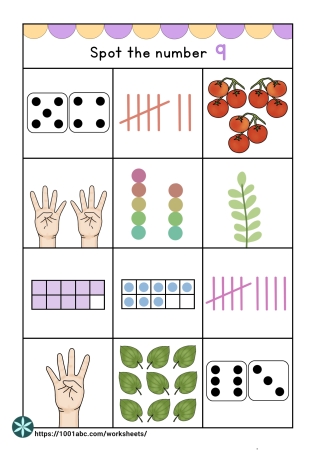
Download page: Number sense 9
Spot the Number 10
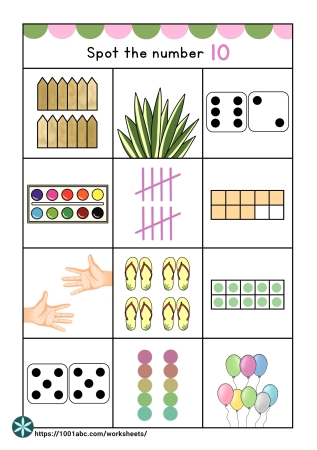
Download page: Number sense 10
Variations & Extensions
Children can continue practicing number–quantity relationships using everyday materials, such as:
- Show a number card and ask children to make the quantity using their fingers.
- Give children a number and ask them to collect that many objects.
- Roll a die and ask children to show the same quantity using their fingers or counters.
- Use a ten-frame and counters to represent a given number.
- Ask children to show the same number in two or three different ways.
- Show two representations and ask whether they represent the same quantity.
- Place several groups of objects together and ask children to find the group that matches a given number.
- Ask children to represent a number by drawing objects, dots, or another visual form.
***
Enjoy every moment of learning and growth with the children!